
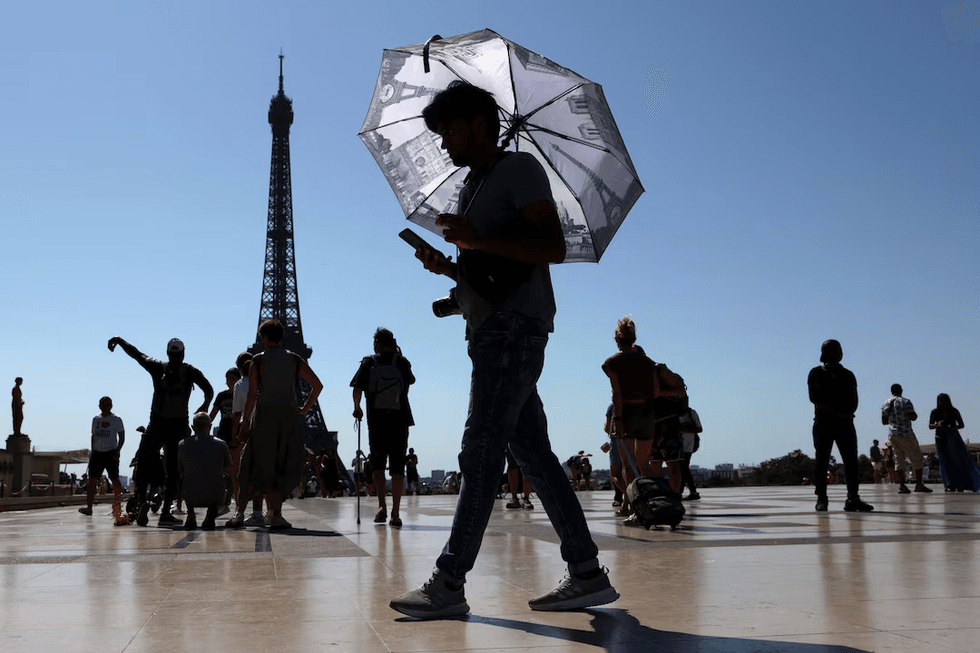
Authorities banned alcohol and cancelled major weekend festivities on Thursday as a deadly Europe heatwave that has overwhelmed hospitals was forecast to shift east on Friday.
Medics in Britain and France warned that hospitals were struggling under the heat and a surge in emergency calls.
How many people have died in the Europe heatwave?
Authorities have reported hundreds of deaths in Spain, with additional fatalities recorded across Europe. Several of the dead include children who died after being left in hot cars. The toll is expected to rise as the heatwave continues shifting toward central and eastern Europe.
Some cooler air moved over western parts of the continent, but central and eastern Europe warned their heatwaves had not yet peaked. The Czech Republic and Hungary were placed on red alert for the weekend, with forecasts predicting temperatures of up to 40C.
What is causing the Europe heatwave?
Scientists say recurring heatwaves are a clear marker of human-driven global warming caused by burning fossil fuels. Researchers expect these events to become more frequent, longer and more intense as the climate continues to warm.
At a homeless shelter in Berlin on Thursday, where temperatures topped 33C, Christian Bernardt, 52, found relief in a cool room. "The heat is exhausting. Nobody was expecting this heatwave," he said. He added that walking between train stations with luggage in the heat was especially tiring.
Samantha Burgess, deputy director of the EU's Copernicus Climate Change Service, said the hot weather stemmed from a "heat dome" of trapped air from North Africa sitting within a low-pressure system. Climate scientist Friederike Otto, co-founder of World Weather Attribution, told reporters the weather pattern itself was not unusual. She said the resulting temperatures would have been far less extreme without human-induced climate change.
Where in Europe is the heatwave hitting hardest?
At least 150 million people in Europe were expected to experience temperatures above 35C on Friday, according to AFP calculations based on forecasts. Maximum temperatures were forecast to exceed 30C for more than 420 million people across Europe, excluding Turkey, or around 70% of the population.
The London Ambulance Service said Wednesday's extreme heat triggered the highest number of life-threatening emergency calls in a single day. France's health ministry reported a fourfold increase in emergency room visits for heat-related reasons, along with a surge in cardiac arrests.
"We are reaching a saturation point in hospital facilities," said Paris police chief Patrice Faure, announcing a rare ban on evening alcohol sales in Paris for the weekend. Paris also postponed its Pride parade, originally scheduled for Saturday afternoon.
Near Italy's Po River estuary, clam fishermen worked to clear algae from their nets, fueled by the heat. "On top of all our problems, now there's this crazy heat, so long, so unexpected," said Paolo Mancin, head of a fishers' cooperative, standing in 31C water. He said the algae growth was killing large numbers of clams.
Authorities in the region warned that low water levels in the Po River threatened to cause a drought, and 18 Italian cities were placed under red alert.
Is the heatwave easing anywhere in Europe?
Western Europe saw some relief after a storm broke overnight in France's Brittany region, bringing cooler air on Friday. "I've come back to life. We can breathe at last," said local resident Aurelie Sauvager, 47. She said the heat had made it hard to go outside, but conditions were finally improving.
Much of the Netherlands remained under red alert, with authorities advising residents to travel only when necessary and most schools closed for the day. Germany and the Netherlands cancelled numerous outdoor festivals and events because of the heat.
Hungary's Prime Minister Peter Magyar said authorities were preparing millions of bags of drinking water for possible public distribution. He urged residents to conserve water as the heatwave moved toward central and eastern Europe.